A few years ago, when I was Deputy Director of the Laboratorio de Gobierno in Chile, a senior civil servant travelled from the far south of the country to Santiago to ask me to run a one-day innovation workshfor his team. We spent nine hours with around 25 highly motivated public servants. The energy in the room was strong. The ideas were thoughtful.
At the end of the session, their boss stood up and said, “I’m disappointed. None of this is really innovation.”
I was fuming, but I did not yet have the language to respond. If this was not innovation, what was it? Was the problem the ideas, the people, or the expectations attached to the word itself?
That moment stayed with me. It led me to a simple conclusion:
Change in government is plural. Not every change should be, or needs to be, innovation.
Change is plural
In government, “innovation” has become an irresistible word. It signals ambition and progress. Civil servants are encouraged to innovate, strategies are written around it, and units are set up to deliver it.
Yet not every change inside government is innovative. Pretending otherwise creates confusion, disappointment and fatigue among the people doing the work.
I say this with some irony, given my current role as Head of Public Sector Innovation at Capacity, a community interest company working with public bodies across the UK. Much of my work involves helping teams experiment, test ideas and learn. But that is precisely why the distinction matters. Innovation is vital, but it is only one form of change.
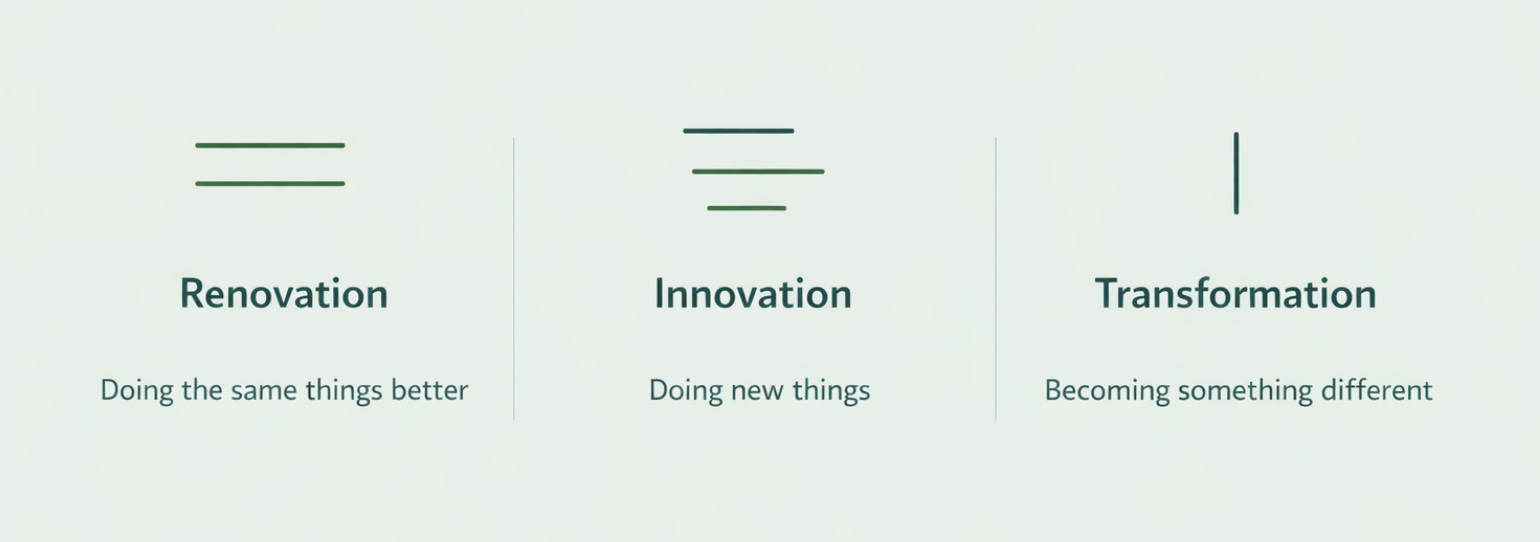
From years of working inside and alongside government, I have found it useful to think about change in three broad forms:
Public Sector Renovation – doing the same things better, improving efficiency and reliability.
Public Sector Innovation – doing new things, introducing new services, models or partnerships.
Public Sector Transformation – becoming something different altogether, reshaping an organisation’s role, structure or identity.
Each form requires different leadership, resources and tolerance for risk. Treating them as interchangeable is one of the quiet reasons reform so often underdelivers.
When all change looks the same
Across central government, local authorities and the wider reform ecosystem, phrases such as “test, learn and grow” and “public service reform” have become familiar. They reflect a genuine effort to make policymaking more adaptive.
But in the rush to appear innovative, there is a tendency to label every pilot, restructure or new digital tool as innovation.
In practice, many of these efforts are renovations. They streamline processes, reduce delays, or upgrade systems. This work is valuable and often essential. But it is not the same as creating something genuinely new, and it is certainly not transformation.
When everything is framed as innovation, expectations drift. Leaders anticipate breakthrough change. Teams focus on keeping services running. The result is frustration on both sides.
Change and the human side of reform
The way change is framed has real consequences for people.
I have seen teams prepare themselves for sweeping transformation, only to find that what followed was a modest process tweak. Over time, that gap eroded trust. Staff became more cautious, relationships between leaders and teams weakened, and the next announcement of “big change” was met with scepticism rather than energy.
Clarity about what kind of change is actually underway is a form of respect. It reduces unnecessary anxiety and avoids overselling small but meaningful improvements as revolutions.
It also creates a healthier environment for experimentation. When not every initiative has to be innovative, teams can focus on learning rather than defending reputations.
Lessons for the UK reform agenda
The UK’s current focus on reform, growth and smarter government is an opportunity to be more honest about change.
When departments design pilots, the first question should not be “Is this innovative?” but “What kind of change are we pursuing?”
Renovation should be judged on smoother delivery.
Innovation on whether it creates new value.
Transformation on whether it genuinely reshapes how government operates.
Making those distinctions explicit helps leaders communicate more credibly and reduces the cycle of over-promising and under-delivering that undermines reform.
A call for more honest reform
Recognising that change is plural is not about lowering ambition. It is about matching ambition to reality.
Innovation still matters. So does the quieter work of renovation, and the rarer, demanding work of transformation.
If we stop insisting that every reform equals innovation, we create space for more authentic learning and more sustainable progress.
Change in government is constant. The real question is whether we understand what kind of change we are actually making.
About the author – Gian Durán is Head of Public Sector Innovation at Capacity, a community interest company (CIC) based in the Liverpool City Region. He leads programmes that help local and central government design and deliver public service reform, build capability, and foster innovation across communities. With over 18 years’ experience in public sector transformation in the UK, Chile and internationally, Gian has advised governments, universities and social impact organisations on strategy, digital capability and service redesign. He holds a PhD in Public Sector Transformation from The University of Manchester, where his research explored how public organisations move from renovation and innovation to true transformation.