
By Adam Terry, Executive Director of FGF
In March 1989, a British computer scientist called Tim Berners-Lee submitted a proposal to his boss at CERN – the European particle physics laboratory near Geneva. Keen to find a better way for scientists to share information across different computers, locations and institutions, he proposed a new system where anyone connected to the network could upload and find specific ‘pages’.
His boss, Mike Sendall, scribbled three words on the proposal: ‘Vague, but exciting.’
As the World Wide Web approaches its fortieth birthday, there is no way Sendall – or Berners-Lee for that matter – could have predicted quite how ‘exciting’ this proposal would be: how it would come to transform almost every pocket of the globe in such dramatic and fundamental ways. This is perhaps the essence of the very best inventions. Creations that are both transformational in their present use, and unknowable in their future potential.
Tim Berners-Lee stands in good company when it comes to British innovators. For an island that is roughly forty times smaller than both the US and China, Britain can boast: the steam engine (1712), the Smallpox Vaccine (1796), the pedal bicycle (1839), the first underground railway (1863), the telephone (1876), Penicillin (1928) and IVF treatment (1978), to name just a few.
And that’s before we get onto the four lads from Liverpool who redefined pop music in the 1960s, British artists from William Blake to David Hockney to Tracey Emin, and literary giants like William Shakespeare, Jane Austen and Hilary Mantel. In short, Britain is fertile territory for invention, creativity and innovation.
Thanks for reading! Subscribe for free to receive new posts and support our work.
Britain’s innovation economy
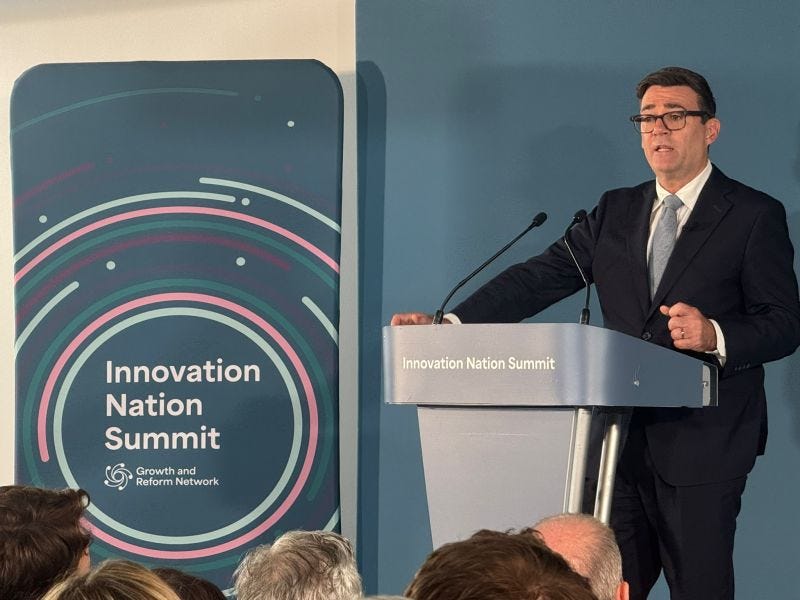
We can and should do more both to celebrate this illustrious past and to think about what the next chapter of the story should be. That was the driving force behind the ‘Innovation Nation’ summit in Manchester last week, hosted by The Growth and Reform Network in partnership with FGF and Metro Dynamics. Fittingly, the summit began with a recorded message from Berners-Lee himself, before former Prime Minister Gordon Brown and the current Prime Minister Andy Burnham took to the stage to address a packed room.
All three speakers had a very clear message: that Britain has been the world’s innovation nation before, and we have the potential to be so again. That we have exceptional scientific and research capability, leading scientific institutions and universities, and major concentrations of industrial capability.
Andy Burnham’s roll call of examples from across the length and breadth of the UK shows the diversity of those existing strengths. There’s the burgeoning creative sector in the Liverpool city region, the advanced manufacturing research centre in South Yorkshire, one of Europe’s largest fintech sectors in Edinburgh, the gaming capital of the continent based in Dundee, a growing photonics industry in Glasgow, clean energy in Newcastle, space research in Leicester, the UK’s biggest electric vehicle battery plant soon to be based in Somerset, quantum research in Oxford, a £100 billion chip design company headquartered in Cambridge, a leading cyber cluster in Belfast, a major semiconductor industry in South Wales and the biggest UK AI cluster by headcount outside of London and the South East in Greater Manchester. Add London to this list, with all its strengths in the creative, fintech, research and AI sectors, and you quickly get a sense of the potential in every pocket of this nation.
Now we need to unleash it. But it won’t be easy: nearly two decades of anaemic growth and stagnating living standards show both how important it is to kickstart the UK economy, and how challenging that is proving to be. Burnham’s answer is to put place at the heart of his theory of growth. His mission to champion good growth in every postcode shows a determination to realise the potential of every nation and region of the UK as engines of growth themselves (and not just recipients of redistributed wealth generated in London and the South East).
Unlocking innovation is integral to that mission. As Gordon Brown argued in The Guardian last week, raising Britain to Swedish or Japanese levels of innovation intensity could leave every household £5,000 better off and increase our national income by £150bn a year. To achieve this, we need to think carefully about how we get there.
Building the Innovation Nation
Creating the right conditions to encourage innovation is a complex and delicate task, but there are clear actions government can take. Firstly, Britain should engage in a race to the top: competing by being the best in knowledge, the best in quality and the best in creativity. We will never outcompete industrialising countries on cost, and nor should we seek to. Instead, Britain should lead the way on international standards, and establish a domestic regulatory framework that offers businesses certainty and consumers and citizens good outcomes, while encouraging innovation and attracting internationally mobile firms. A pro-innovation approach to regulation would also mean ensuring our regulators have the capacity and skills they need to oversee sectors of the economy that are accelerating at a dizzying pace.
As Business Secretary Jonathan Reynolds made clear in his remarks at the summit, we also have to think seriously not just about how we get innovative British businesses to start up, but how we get them to scale up – and then stay here in the UK. We are dwarfed by the US when it comes to the volume and speed of companies scaling, and too often when we do have success stories of our own, they relocate abroad to take advantage of the economic benefits in other countries. Changing this means directing more capital towards the later stages of a business’s growth journey, be that through the power of public procurement, concerted efforts by public finance institutions like the National Wealth Fund or the British Business Bank (BBB), or incentivising investment through ongoing pension reforms or changes to the tax system (where we’ve been pleased to see FGF ideas taken up by the Labour government over the last few years).
Getting this right is not only about who gives the funding, though; it’s about who gets it. Recent FGF research shows female, disabled and ethnic minority entrepreneurs, and founders without inherited wealth or established networks, consistently struggle to gain access to funds to scale their businesses. We found that closing the funding gap for these innovators through initiatives like the BBB’s Investor Pathways Capital Fund or our proposal for a new Youth Enterprise Scheme could change the game for our innovation economy.
These economic foundations must also be underpinned by political reform. To allow nations and regions to set their own ambitions and then create the conditions for innovation within their local economies to achieve them, power must continue to be pushed out of Whitehall and Westminster. Burnham’s plans to rewire the state and go further on devolution will be important for developing a framework through which national and local institutions can act together, and through which mayors and strategic authorities can unleash the potential of their regions. If ‘growth in every postcode’ is to become more than a slogan, getting the details of that ambitious devolution agenda right will be critical.
The clock is ticking for the new administration to make headway on this. There are now less than three years until the next election, and voters are increasingly, and understandably, impatient for the change they keep voting for. Chancellor John Healey’s upcoming first Budget, followed in quick succession by a devolution white paper and a new 10 Year Plan, are important opportunities to show that this government can operate on two timescales at once: bringing immediate cost-of-living relief and ‘breathing space’ today, while embarking on the deeper structural reforms that will set Britain on a path of more investment, more innovation and a return to growth.