
By Matt Bevington, FGF Policy Associate
In a new report out today, we are calling for the Chancellor to give mayors the powers and funding to pursue a new, progressive form of public-private partnership called Mayoral Infrastructure Investment Partnerships.
These build on the Infrastructure Investment Partnership (IIP) model we put forward in 2024, and we are delighted to have the backing of leading experts in this area, including the former Welsh Finance Minister Rebecca Evans, James Kirkup – Partner Apella Advisors and Mike Reader MP – Chair of the Infrastructure APPG.
Britain’s crumbling public realm
Good growth and regeneration are, rightly, urgent priorities for the government. Yet time until the next election is short.
Britain’s public realm is today in a worse state than when we penned our previous FGF report on PPPs in 2024. The NHS estate maintenance backlog alone rose by £2.1bn in 2024-25, to almost £16bn.
“The United Kingdom has invested less [in infrastructure], relative to the size of its economy, than almost every comparable country for more than a quarter of a century” Oxford Economics
Many communities across the country feel they have been neglected. These figures help explain why.
Repeating mistakes of cutting capital spending
For understandable but unfortunate reasons, Labour has repeated the mistake of previous governments by deciding to cut capital spending to plug a short-term gap in defence funding.
Our fiscal constraints are inarguable. There is a strong moral case against loading ever more debt on the next generation. But there is an equally strong moral case against deferring investment. We are set to hand the next generation schools, hospitals and public housing that will have to be rebuilt sooner and have more severe failures that are more expensive to fix because we failed to maintain them properly.
What’s changed from PFI?
Britain was a pioneer of public-private partnerships (PPPs) in the 1990s and 2000s through the Private Finance Initiative (PFI) initiative. Much was achieved but as an early adopter we also suffered the early-mover penalty and mistakes were made.
When the Coalition came to power in 2010, use of PFIs was scaled back, and in 2018, under Theresa May, PFI was formally abolished.
In the eight years since, the UK’s devolved governments have continued to do what the Westminster government stopped doing: showing how reformed PPP models can deliver the infrastructure we need while bringing social, environmental and community benefits at the same time.
Wales introduced the Mutual Investment Model (MIM) in 2017. The MIM includes public-sector equity stakes, a public director on project boards, much greater transparency and a system of community benefits.
Devolving money freed up from expiring PFI contracts to mayors
Our proposed model – Mayoral Infrastructure Investment Partnerships – goes further.
Decision-making needs to be moved closer to the communities affected by these projects, to people with skin in the game. We would hand Mayoral Infrastructure Investment Partnerships to mayors to invest in strategic regeneration projects, supported by a new source of revenue.
PFI contracts can be simplified into two broad categories. First, operations and maintenance costs to keep buildings running and in a fit state. And, second, capital and interest, repaying the debt taken out to finance construction (plus interest), and a return for equity investors. The National Audit Office (NAO) put these at roughly 60% and 40% of contract costs respectively.
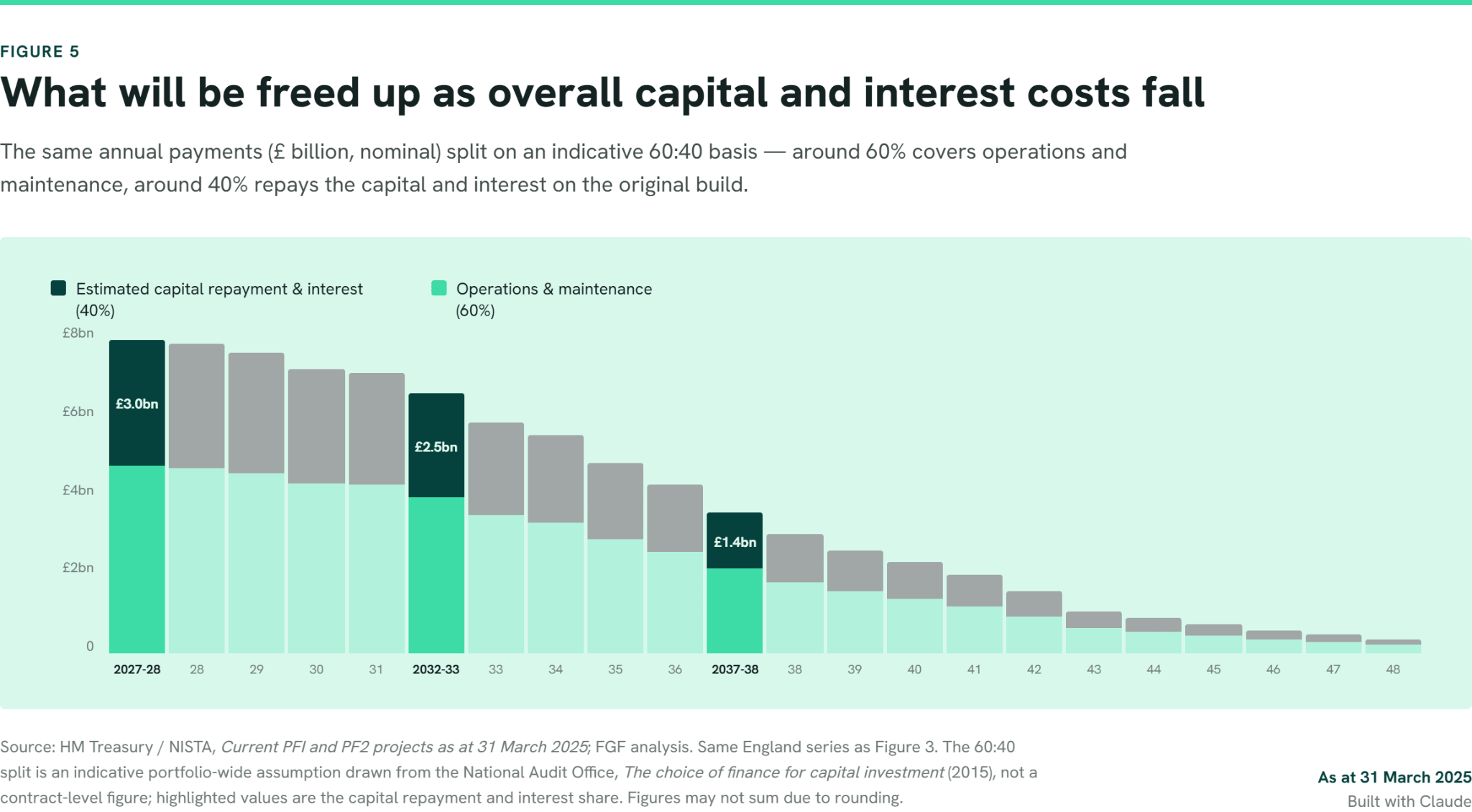
We are now past the peak of PFI repayments, so each year from hereon costs will fall. We will still have the buildings that need to run and maintained, so the 60% share needs to be kept in place. But the 40% will become available.
Over the next five years, around £500mn/year will be freed up, rising to £1.7bn by 2037. This should be redistributed to Mayoral Strategic Authorities (MSAs) as ringfenced funding to reinvest in strategic public infrastructure projects. Distributed crudely by population share, an average-sized MSA like the North East would get an additional £17mn a year by 2032, rising to £58mn by 2037.
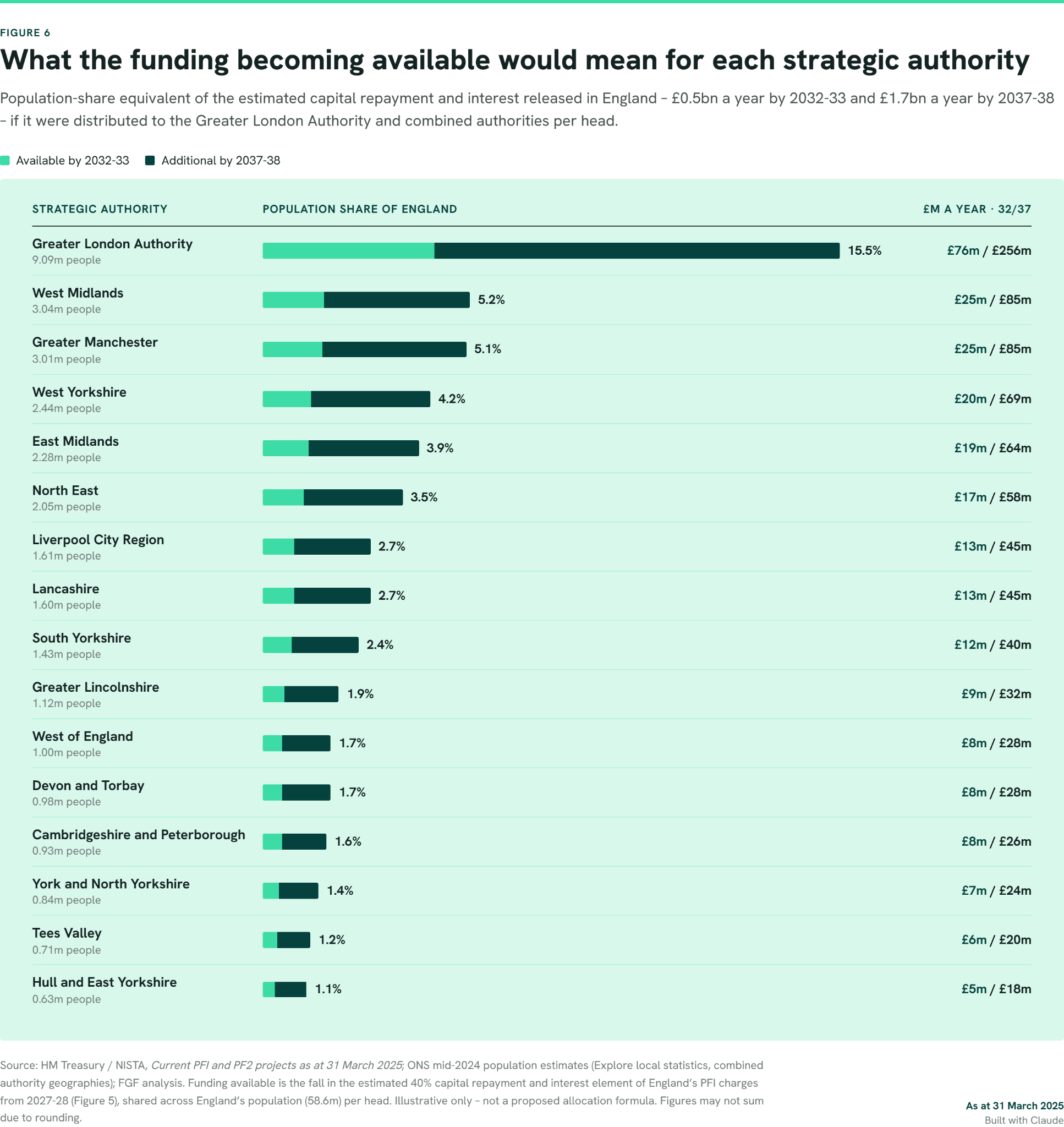
This is recycling existing spending, not a new commitment. It would ensure that existing levels of public infrastructure investment are not further winnowed away.
Governance and accountability
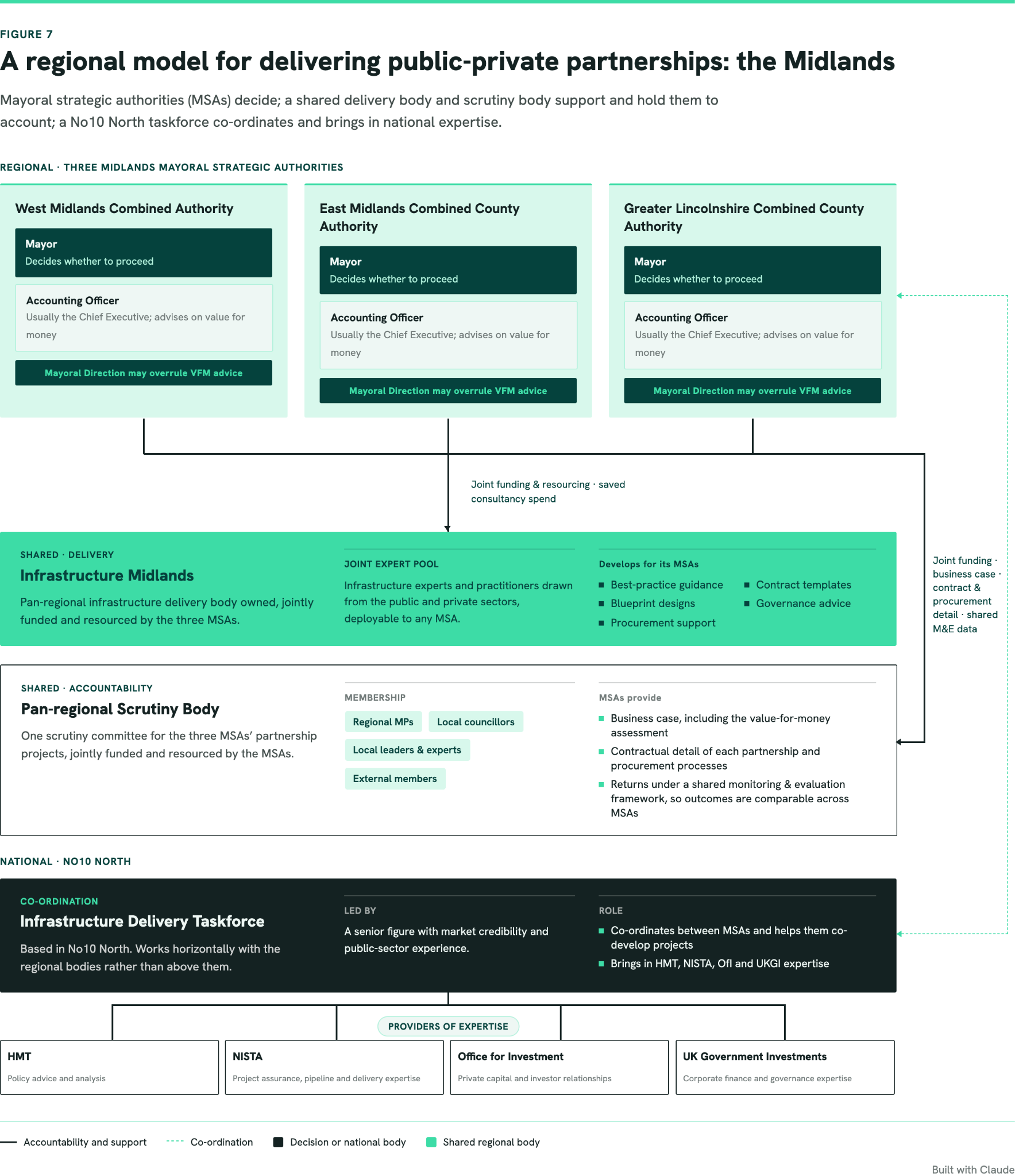
Elected mayors should have the final decision on whether projects proceed or not, so they can be accountable to voters. MSA Chief Executives being given Accounting Officer (AO) responsibility will provide a check to ensure public money is used responsibly. If mayors wish to over-rule their AO, we argue they should be required to publish a Mayoral Direction – similar to a Ministerial Direction in Whitehall – that sets out transparently their rationale.
Pan-regional institutions
In addition, we propose two new pan-regional institutions.
The first would be shared infrastructure delivery bodies, such as Infrastructure Midlands for the West Midlands, East Midlands and Greater Lincolnshire. They would provide wide-ranging support across all infrastructure delivery in the region, including a shared pool of expertise. This would help MSAs to spread the cost and reduce consultancy spend.
The second would be shared scrutiny bodies. For PPPs, these would scrutinise business cases, contracts, and monitor ongoing performance. Spreading the cost would again reduce the burden, and help newer and smaller MSAs in particular.
No10 North Infrastructure Delivery Taskforce
For all this, there needs to be a central delivery and co-ordination body that has credibility with mayors. We propose a new Infrastructure Delivery Taskforce in No10 North, led by a senior figure with private- and public-sector experience, and staffed by top talent from the Treasury, National Infrastructure and Service Transformation Authority and the Office for Investment and UK Government Investment. Its role should be to progress as many MSA projects as possible ahead of the next election.
Long-term investment partner
Finally, we suggest mayors should appoint a long-term investment partner, such as a pension fund, as they develop these projects. This would bring much-needed private-sector expertise and discipline. It would also help MSAs to manage these assets well over the long term, with public and private incentives aligned.
As we said in Rebuilding the Nation: 03 Infrastructure Investment Partnerships, in practice the choice of how to finance major new public infrastructure is often not public or private, but private or nothing. If the government wants to go into the next election with a compelling story about how it is transforming communities, and visible proof of that story being delivered, then Mayoral Infrastructure Investment Partnerships provide a credible mechanism to do that.