
Andy Burnham began his time in office with the striking Rewiring the State cabinet statement, in which he promised ‘a new framework for governing’ across the UK. It was a bold signal of intent for his coming premiership.
In the statement, the Prime Minister set out plans for a smaller central state, devolution of responsibilities for a greater set of policy decisions and fiscal powers, and a new principle of ‘devolving by default’. Ministers will even have to justify retaining powers that, in many cases, they have spent a career trying to attain.
Should it be realised, this project will shake up the state – particularly in England – in a profound way, demanding a significant amount of energy and political capital.
Two ‘Rewiring’ Projects
This radical reform of the state will not happen in isolation. It coincides with the massive physical overhaul of the UK’s energy system. By early 2027, the National Energy System Operator (NESO) will have published regional and national plans covering our entire energy system, guiding decisions on which projects get built and where.
The clean power transition will determine where hundreds of billions of public and private money is invested, the places that get to shape and benefit from it, and what story gets told along the way – in every postcode.
Pursuing both of these ambitions in tandem means Burnham has two massive ‘rewiring projects’ – one quite literal – on the go at once. At FGF we want them both to work, and to work synergistically. To that end, we’ve been speaking with practitioners, politicians, pollsters, civil servants, developers, start-ups and academics in recent months to discuss three interconnected questions:
-
Money: What are the best available financial tools to match the opportunity, and what are the greatest barriers to progress?
-
Place: How well do existing policies and governance arrangements serve places and their ambitions, and what role should devolution play in supporting the delivery of clean energy?
-
Purpose: Across a highly complex and technical task that can feel abstract to many, what story should narrate the transition to clean power? And what actions demonstrate purpose in a visible way?
Ministers and devolved leaders will need to grapple with difficult trade-offs to connect these major political and energy transitions. And they will be asked about money, place and the overriding purpose as they seek to make decisions, justify the trade-offs involved, and respond to bumps in the road.
While the new PM has been less vocal about the energy transition than many had hoped, some persuasive case studies do point toward options to connect his ambitions for state reform with the move to clean energy. It won’t be possible to do everything all at once, though, so clear principles will need to guide which initiatives prioritised and what risks are taken. All of them are big and costly, but none are more expensive than keeping the status quo. At some point, big calls will need to be taken to accelerate the electrification process that will deliver the benefits of clean power at scale – a fact rightly acknowledged by Energy Secretary Miatta Fahnbulleh this week.
Sharing power
As more power and responsibility is handed down to the regional level, ultimately allowing them to take more risks, there is a big question as to what role Whitehall – and particularly the Treasury – should play over the long term.
Mayors will want to see greater powers, including fiscal devolution, added to their armoury so as to maximise the impact of their local plans for growth, transport and energy planning. Scotland and Wales – both home to some of the most acute flashpoints in the energy transition – have many of the relevant policy tools already devolved, but are rightly frustrated that much of the debate on local growth, climate change, energy and resilience fails to engage with the reality of national devolution. Understandably, they will want to know how that will change.
As NESO’s new plans take root, there is also a question around how this major technocratic planning exercise interacts with the politics of the regions, nations and Westminster. As we have observed with the creation of Great British Railways, the development of a single guiding mind could collide with the political reality of devolution, especially for a PM who insists upon ‘devolution not delegation’.
A debate for a further Substack is how the government should embrace storing and spreading clean energy to deliver the cheapest possible supply at all times – a job we think is right for a more strategic central state that gets out of the weeds of local delivery.
Paying for windfarms to switch off for periods only to lean on gas is a maddening, expensive symptom of the status quo. Railing against a terrible symptom is fine as far as it goes, but it doesn’t make gas dependence any cheaper or more secure. Scaling up battery storage for release at those moments will be cheaper and better for the climate over the long term. In this rewired state, central government should lead in working through these sorts of structural dilemmas and let go of the impulse to micro-manage elsewhere in the system. All of which gets into the some of the thornier questions around power for the Burnham administration: what to hold or bring back to the centre, and what to give away to the nations, regions and local authorities.
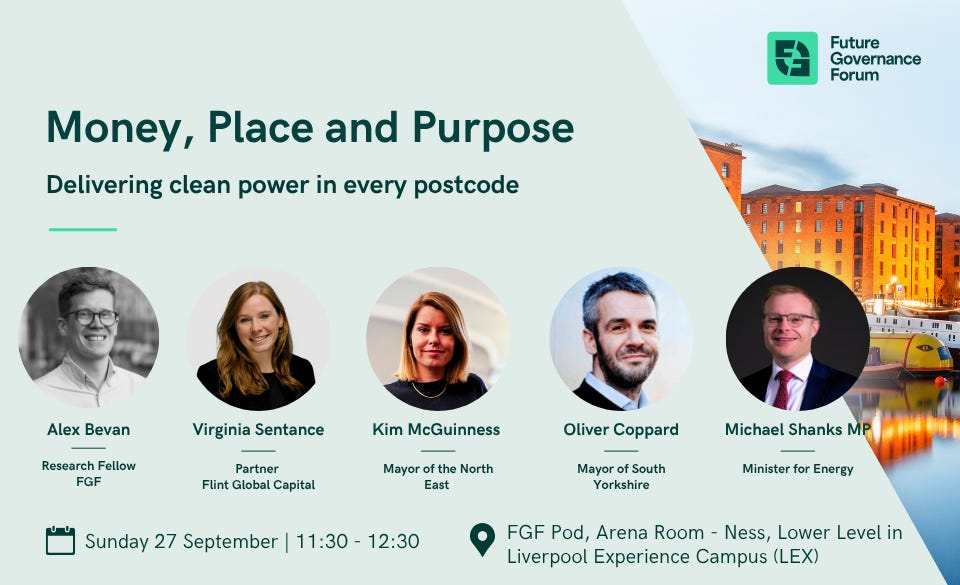
The challenges and questions surrounding this transition are many, but the value of getting it right is enormous. We will be exploring all of this at the Labour Party Conference in Liverpool tomorrow, with a stellar lineup including:
-
Michael Shanks MP, Minister for Energy
-
Kim McGuinness, Mayor of the North East
-
Oliver Coppard, Mayor of South Yorkshire
-
Virginia Sentance MBE, Partner at Flint Global, climate policy expert and former Cabinet Office civil servant
Join us if you can, Sunday 27th, 11:30 – 12:30, Arena Room – Ness, and watch this space for more thinking on the topic of clean power and the wiring that comes with it.