
When it comes to public services, the word ‘preventative’ gets used a lot. For decades now, the idea that we need to shift to preventing crises rather than picking up the pieces after they’ve happened has had close to universal agreement. The problem is that shift never happened. When individuals and families start to struggle – whether with the transition to adulthood, the challenges of parenting while struggling with deprivation and exclusion, or with early signs of coercive control or violence in a relationship – they simply do not believe that public services will help.
When services do intervene in their lives, it’s often because a crisis point has been reached: a ‘risk level’, ‘threshold’ or ‘referral’ has been triggered. Too often, public services lack the kind of deep and long-term engagement with communities that is required to create an environment where people will voluntarily seek help. That would be real prevention.
Understanding prevention
If anyone understands why people won’t seek help until a crisis point, and how to build the trust needed to change that, it’s civil society. Unfortunately, these voices are currently almost always absent from the rooms where the theorising about public services happens. To change this, I convened the Social Insights Panel for the Future Governance Forum, which brings the strategic and frontline experience of civil society organisations – from large national charities to small, local and voluntary groups – to the attention of those in government who are trying to reform public services.
Making the shift towards real prevention could hardly be more urgent. I could pick many examples to demonstrate this. Whilst the government has promised to halve violence against women and girls in a decade, the police still receive a domestic abuse call every 30 seconds in England and Wales. And in the year ending March 2025, 7.8% of people aged 16+ (around 3.8m people) experienced domestic abuse. When it comes to young people, 83,000 children were living in care as of 2023 – a 23% increase over the past decade. And 800,000 young people aged 16–24 in England are currently not in education, employment or training (NEET).
The Social Insights Panel has published its first report, which focused on three areas: ending violence against women and girls, supporting transitions to adulthood, and building integrated and preventative family support. These are three of the areas in which the government is applying a ‘Test, Learn and Grow’ approach to public service reform, which presents a timely opportunity to consider what a truly preventative approach would look like, and what public services can do to enable it.
Our hypothesis was that the same obstacles to prevention would crop up in all three areas, and so it proved. We found a misunderstanding right across the system of how real prevention is achieved in the first place. It doesn’t look like traditional public service delivery at all. Rather than top-down interventions in a local area, real prevention relies on the resilience, cohesion and support networks that either already exist in communities, or that can be enabled if public services embrace a completely different relationship with local community groups and organisations.
The web of support
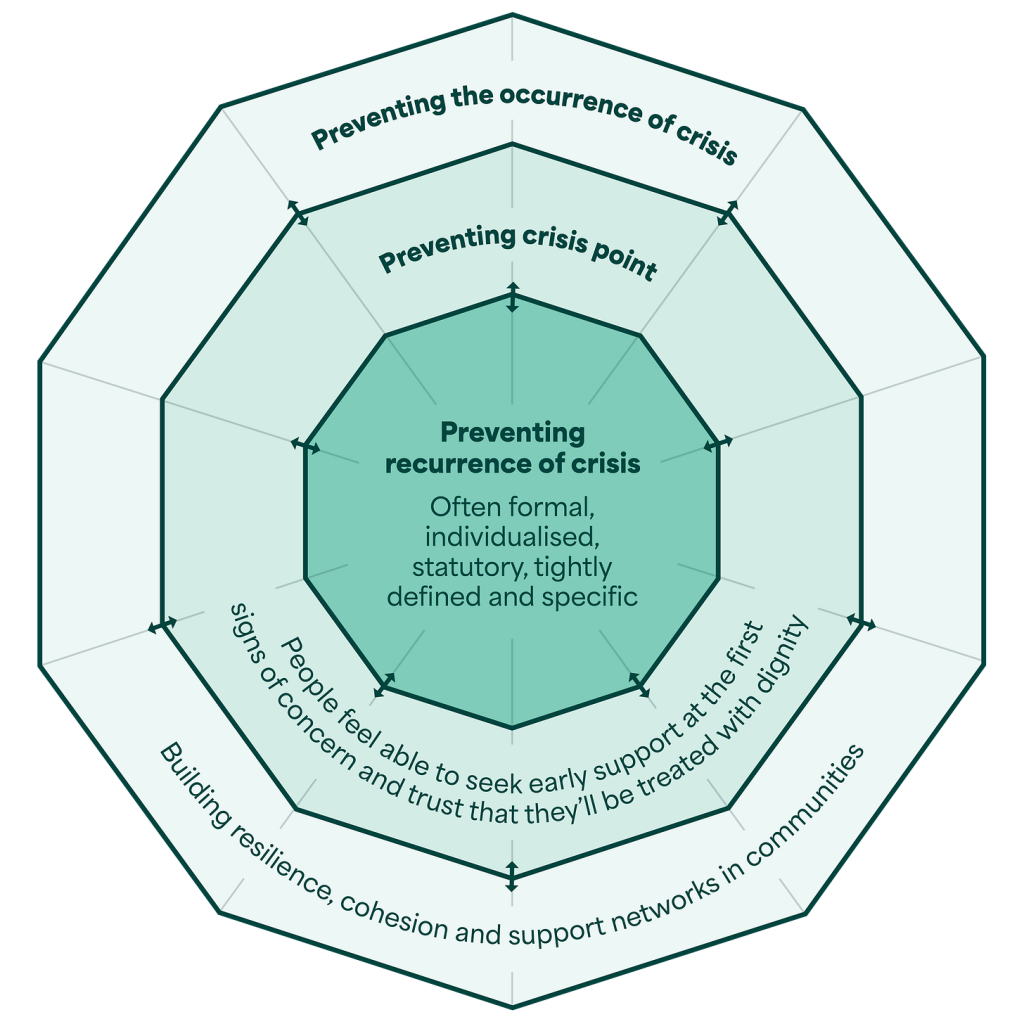
These networks take many forms. They might look like a regular, informal shared meal where women feel safe enough to discuss the earliest signs of domestic violence, or a young person finding the confidence to find a job through the relationships they’ve built in a dance club. These informal networks sit at the outer edges of a ‘web of support’: they can prevent people from needing formal intervention in the first place, or they can be entry points into the support that public services can offer.
However, across all three policy areas, we found that resources and attention are heavily concentrated at the centre, while the community-based structures that make early intervention possible – or prevent its need altogether – are often underfunded, fragile, or, in many local areas, are disappearing altogether.
A mindset shift
Changing this will require a fundamental change of mindset in our public services – in what they value, what they fund, and what they trust. The panel I chair has identified six ‘breakthroughs’ which we believe are vital if the government’s efforts to rethink how public services can become truly preventative are to succeed. What links them all is a philosophical shift away from seeing services as top-down interventions that are often temporary and reactive, and towards an approach that prioritises trust, community relationships and local context.
This philosophical shift is at the root of our six breakthroughs. It recognises the importance of relationships, whether that’s encouraging the government to tackle loneliness and create meaningful opportunities for belonging – both of which are fundamental if people are to feel safe enough to seek help – or shifting the focus onto individual experience and need, rather than focusing on risk levels and thresholds. Only by shifting our thinking in this way can we hope to build the kind of effective webs of support across and beyond public services that can help solve the wicked problems that have eluded reformers for generations.
Investing in the edges of the web does more than offer real prevention for people who need it – although that is prize enough. By strengthening bonds between people, and boosting community infrastructure, we can increase trust in public services themselves, and begin to rebuild the fabric of our communities that has split and frayed over the last decade.
This was, in many regards, something the Prime Minister hinted at before he was elected. He promised that, if Labour came to power, the state would begin to “tread more lightly on people’s lives.” And in his first King’s Speech debate, he spoke of the overwhelming importance of rebuilding trust in government and the services it provides. Those words should have laid the ground for the exact kinds of shifts we are recommending.
Living up to this promise means building the kind of relationships, local infrastructure and community bonds that ensure people can find the help they need, without having intervention imposed upon them once they reach a crisis point. It means strengthening community bonds and social capital to rebuild trust across the UK. And it means shifting our understanding of how public services should be delivered to meet our diverse communities where they are, rather than where government wants them t