In the wake of Reform UK gains across the country, the Prime Minister reasserted that the Pride in Place (PiP) programme remains a priority for this Government. The investment comes at a pivotal moment, emphasising community power and community-led regeneration in the face of Reform’s grievance politics. And at up to £5 billion over ten years, it is one of the largest investments in deprived communities for a generation — a chance to put doubly disadvantaged neighbourhoods at the heart of national renewal.
At Grapevine, we have spent over 20 years building relationships and power in disadvantaged communities in Coventry, some of whom will receive these funds. We have shown it is possible to strengthen communities’ capacity to act on issues they care about, as Pride in Place (PiP) intends. Now, to fulfil the programme’s potential, government needs to get clear on how to deliver these goals.
Issues to resolve
When it comes to implementation, with three ambitious, competing objectives on cohesion, physical infrastructure, and community control, the programme may be trying to do too many things at once. As the investment targets hyper-local pockets of deprivation that have missed out on funds for many years, it will be like water falling on parched ground: money could be rapidly soaked up meeting immediate service and infrastructure needs. It is also under pressure to take quick, visible action addressing the threat from Reform.
Government needs to prioritise more clearly, or these physical infrastructure needs and pressure for urgent results will consume all the energy and resources. This would be a mistake. The relational and capacity building aspects of PiP, though harder to see, are fundamental to its vision for renewal and community power. There is also an ordering issue: we cannot have all three objectives at once. We first need to build relational capacity for inclusive participation so that communities have control of the agenda and can determine their priorities. This community power can support relational work and enable infrastructure decisions that reflect neighbourhood priorities, progressively strengthening both capacity and cohesion. Physical regeneration would increase, and these objectives are ultimately reinforcing — but the engine for the cycle is the relational capacity to exert power to improve things.
Five tests for inclusive renewal
Grapevine has developed five tests which can help guide the Pride in Place programme design towards inclusive power and partnership building. These draw on our work, backed up by wider theory and practice. They also align with The Future Governance Forum’s framework for a new relationship between people and the state at neighbourhood level, based on a reinforcing cycle between neighbourhoods’ self-defined priorities and outcomes, the power people have and their collective capability to wield it, and individuals’ growing participation.
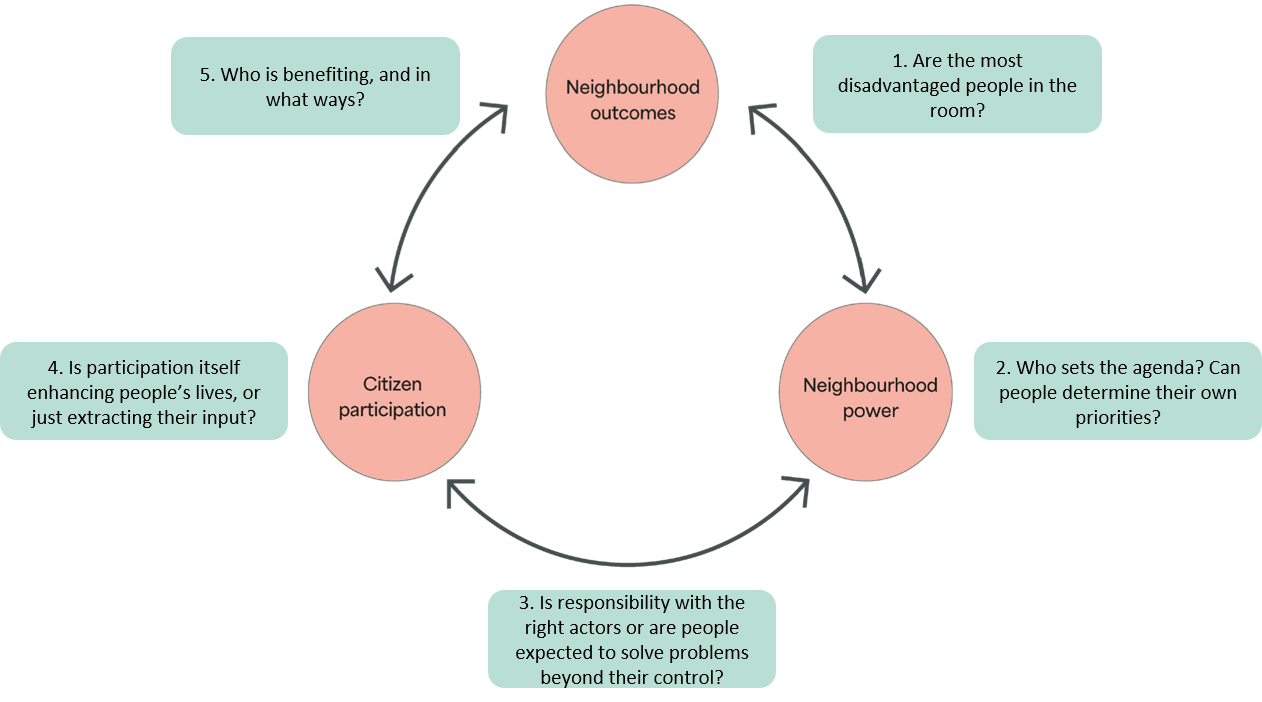
1. Are the most disadvantaged people in the room?
The programme must ensure disadvantaged residents aren’t crowded out in the rush to act. Energy is often latent, invisible, or crushed by disbelief in the communities that have it hardest. Participation processes tend to favour those with the most resources — time, confidence, cultural and social capital — and exclude those who face multiple disadvantages but are closest to the issues. We saw this with Big Local, where resources flowed to organised communities while the most marginalised lost out again. Achieving inclusivity by bringing groups together and navigating tensions takes significant work, but it is critical if the programme is to strengthen cohesion and reduce division.
It is not enough to make processes more accessible — participation depends on relationships and trust to bring people in. Initiatives should therefore start with relational work that connects to people who are excluded and brings different people together in conversations rooted in their actual lives, priorities and networks. This inclusive capability building is foundational to people forming connections and engaging on their terms. Consider Dorothy, a Cameroonian refugee in Willenhall, a Pride in Place neighbourhood. She now leads an exercise group of 50 mainly migrant women, supporting members facing deportation, eviction, and displacement from Ukraine. But Dorothy’s leadership didn’t emerge in a vacuum: our community organiser spent two years building relationships in her neighbourhood before she was ready to partner with institutions as an equal. Dorothy wasn’t in the room at the start – getting there took work.
2. Is responsibility with the right actors, or are people expected to solve problems beyond their control?
While inclusion is critical, this cannot mean loading responsibility onto people to solve systemic issues driven by structural disadvantage. When we go to the roots of people’s challenges, we find they cannot always be solved by the levers at their disposal. We need realism about what this programme can change. Evidence from the Big Local programme shows that community resilience depends on the whole system, not just residents. While it’s a good start that PiP assumes roles on the Board for businesses and local government, wider structural factors need recognising too.
3. Does participation enhance people’s lives, or extract their input?
Participation isn’t a good in itself, it must be meaningful. People get value from connections that give something back to them, so we need to invest in strong relationships and a collective sense of belonging. People also need to make real choices, feel their agency and see its benefits. Pride in Place should be asking: what is the offer for local people in these communities? If the real answer is “not much, but we’d like your views,” people will see through it quickly. Tokenistic participation is worse than none, because it burns trust. If the honest answer is “you get to work with others on something that genuinely matters to you, with real support to bring about local change” — that’s a different proposition entirely.
4. Who sets the agenda?
The Pride in Place prospectus includes a pre-approved menu of interventions. The instinct is often to build compliance frameworks first, then invite communities to decide within them; in our experience — echoed by Big Local’s — this is the wrong way around. When residents are given real control over money, they are often more anxious than local authorities about ensuring it is spent well, and accountability runs sideways to each other, not upward to government. Our Brookstray Park campaign looked like a community group that built a plan and helped direct £300,000 of investment, but the engine underneath was mutual accountability between neighbours. The point isn’t just the improvement. It’s the agency, shared decision-making experience, and relationships formed, which build the muscle for the next community-led change. A pre-approved intervention list is precisely the sort of mechanism that could have blocked this. For Pride in Place to be a genuine transfer of power, it needs to trust communities with the latitude to name priorities government hasn’t anticipated through the data. This isn’t about who chooses between options someone else has designed, but who decides what the question is in the first place.
5. Who is actually benefitting, and in what way?
What is the money actually for? Pride in Place is structured as 63% capital, 37% revenue, and we are pouring twenty million pounds of water onto parched ground. Local authorities have been starved of funds for over a decade, and there is enormous pressure to plug gaps and deliver visible change quickly. But if spend goes to meeting immediate need and doesn’t prioritise civic capacity building, we will have missed the chief goal of the programme. The best outcome of Pride in Place nationally won’t be buildings or services. In each case it should be a more powerful community that can identify its own priorities, listen to itself, take action, advocate, and work with others. That is the regenerative way to work, which will solve problems into the future and beyond the edges of any defined programme or government tenure.
Implications for planning and evaluation
Pride in Place needs to be truly inclusive – and it can be. But this will take both a shift in narrative towards more inclusive capability building, and a willingness to name and invest in the relational capacity for it. Planning and evaluation should acknowledge three things:
We have to recognise and value an asset that is harder to see. Government policy increasingly recognises relationships as a core component of society’s ability to achieve collective ends: what Dan Honig terms ‘relational state capacity’. As Polly Mackenzie recently argued, the mission-led approach acknowledges that government can’t command outcomes it doesn’t directly control, but can instead shape incentives, build coalitions, and give people permission to move together. This ability to act with permission, within systems, takes relational capacity at every level. It is the very logic behind Pride in Place. Relational capacity being less tangible than physical infrastructure does not make it less important, but it is harder to see, value and defend under budget and communication pressures. Government needs to resist that temptation and commit to what it knows: that renewal happens through collective work and partnership. Programme guidance and associated metrics need to determine how to couple funding with meaningful investment in the relational capacity that makes community action possible.
Community renewal in the most deprived areas will require relational capacity-building. It takes skilled, sustained work to build connections, bring people together, and address polarisation and division, particularly where social infrastructure has been eroded by years of disinvestment. The local leaders, innovators, and volunteers who emerge are already there; paid organisers provide the connective tissue that helps people find each other and act together. The invisible labour of organising is what makes visible change possible, so dedicated resources need to go to this work. Capacity building cannot be bolted on to a funding stream; it has to be woven into how money reaches communities and how it is held locally.
We should accept a slower pace for higher value work. Government will find this uncomfortable given the pressure for quick, visible outputs created by budget cycles and electoral concerns. But as Alex Boys recently reflected from his experience of the Big Local programme, many areas spent a long time working through conflicts before arriving at proposals that were genuinely owned by the community. Jumping in too quickly risks decisions people don’t feel are theirs, which burns the trust that is in such short supply. In Willenhall, decades of austerity had eroded people’s confidence that change was possible. It took two years of relational work to rebuild the trust and connections needed to act collectively. Evaluation in 2024 found that, as a result of our Community Organising, people felt more connected, community leadership had grown, and people were more confident in how power moves. Crucially, they felt three times more able to shape local decisions than the national and regional average.
This is what Pride in Place is aiming for, but it takes space to realise it. For us, the measure of success will be whether, years from now, the people we work alongside are more powerful than they were before the programme started — more connected, more confident in shaping decisions, more able to rise to meet their own challenges.
The prize
The communities we work with have seen promises before, and yet there is real hope. Pride in Place has the potential to demonstrate what neighbourhood-led renewal can achieve at scale: a country where neighbourhoods are genuinely empowered to shape decisions, where relationships become the foundation of renewal, and where government enables rather than controls. Not replacing the state, but fundamentally changing how it works and who it works with.
The scale of investment, the ten-year commitment, and the emphasis on community-led decision making are genuinely encouraging foundations. But this vision only becomes reality if Pride in Place explicitly funds the invisible infrastructure that makes visible change possible. Whether the programme lives up to its promise depends on whether it backs that ambition with the patience, flexibility and trust to let communities lead.